
The Precision Penalty: Why Meta is Ghosting Your Unstructured Support Bot (And How to Fix It)
Unstructured AI chatbots can trigger Meta’s Precision Penalty, lowering WhatsApp messaging limits. Learn how structured automation protects your Quality Score.
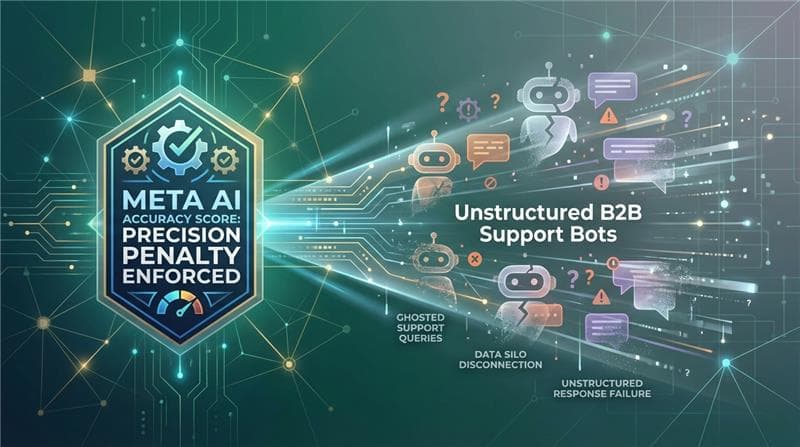
Imagine waking up on a Tuesday morning to check your WhatsApp Business API dashboard. Yesterday, you had a messaging limit of 10,000 customers per day. Today, you’re capped at 1,000. Your traffic has been throttled, your campaigns are stalled, and your Quality Rating has shifted from a healthy "Green" to a critical "Red."
You haven’t changed your volume. You haven’t changed your templates. So, what happened?
Welcome to the era of The Precision Penalty.
For the last few years, the metric that mattered most was speed. But in 2025, Meta quietly shifted the battlefield. It is no longer enough to reply instantly; you must reply accurately. Unstructured, "black box" AI chatbots—once hailed as the future of customer support—are now triggering algorithmic tripwires that can effectively "ghost" your business from its own customers.
Here is why your Quality Score is plummeting and how to survive the shift to Precision Support.
The Trap of "Black Box" AI
- For years, B2B companies rushed to deploy "set it and forget it" generative AI bots. The promise was alluring: feed the bot a PDF of your policy, and let it chat. However, a hidden cost has emerged.
- When an unstructured bot "hallucinates"—invents a policy, promises a non-existent refund, or gives a vague, circular answer—users rarely offer a second chance. In the intimate environment of WhatsApp, a bad bot interaction feels personal. Users don't just close the chat; they hit "Block" or "Report Spam."
- Under Meta’s enforcement algorithms, these negative user signals are catastrophic. They are the primary driver behind a tanking Quality Rating.
The High Cost of Hallucinations
- The financial and reputational damage of unstructured AI is no longer hypothetical; it is measurable.
- Global Impact: Business losses attributed to AI hallucinations reached approximately $67.4 billion in 2024.
- The Trust Gap: In 2024, 47% of enterprise AI users admitted to making at least one major business decision based on hallucinated or incorrect AI content. This erosion of trust has trickled down to the consumer. When a user feels they are talking to a "dumb" bot, they report the number. Meta’s algorithm sees this spike in negative feedback and applies the Precision Penalty, restricting your ability to send outbound messages.
Meta’s New Rules of Engagement (2025)
- The landscape has changed significantly with Meta’s implementation of "Template Integrity" audits.
- In the past, poor automation could hide in plain sight. Now, Meta utilizes its own AI to audit conversation quality and reclassify templates in real-time. Messages previously categorized as cheap "Utility" conversations (like shipping updates) are now being flagged and re-billed as expensive "Marketing" conversations if the AI detects vagueness or promotional drift.
- This automated auditing means accuracy is now a visibility metric. If your bot drifts off-topic, your costs go up, and your reach goes down.
The "Glass Box" Approach: How Whatatalk Solves The Precision Penalty
To keep your Quality Score green in 2025, you need to move from "Black Box" improvisation to "Glass Box" transparency. At Whatatalk, we believe the solution isn't to remove automation, but to structure it.
Here is how our platform protects your domain reputation:
1. From Guessing to Guiding (Interactive Messages)
- The quickest way to trigger a hallucination is to let an AI guess the answer to an open-ended question.
- The Whatatalk Fix: Instead of improvisation, we use Interactive Messages (Lists & Buttons) synced with your Catalogue Config.
- Rather than typing "I need a refund," and hoping the bot understands context, the user selects from a predefined menu.
- This guides the user down a precise, pre-verified path.
- Result: 100% accuracy, zero hallucinations, and a protected Quality Score.
2. The Human Safety Net (Shared Team Inbox)
- There is a specific moment in customer support where automation fails and frustration begins. Unstructured bots keep talking in circles during this phase.
- The Whatatalk Fix: We employ a Human-in-the-Loop approach via our Shared Team Inbox.
- When a conversation becomes complex, your team has total visibility.
- An agent can "swoop in" instantly to take over from the bot.
- Result: This rescue capability prevents the user frustration that leads to blocking, preserving your tier limits.
3. Relevance Over Volume (Targeted Campaigns)
- "Spray and pray" broadcasts are the fastest way to get flagged as spam. If you send a generic blast to 10,000 people, a percentage will inevitably report it.
- The Whatatalk Fix: Our Targeted Campaigns leverage Smart Tagging.
- Segment your audience based on behavior and history (e.g., "Active B2B Leads" or "Pending Support Tickets").
- Send highly relevant content only to those who want it.
- Result: High engagement rates signal to Meta that your number is high-value, actually increasing your messaging limits over time.
Conclusion: Survival of the Most Precise
The era of the unstructured chatbot is ending. In 2026 and beyond, the most successful support strategy isn't the one that talks the most; it's the one that makes the fewest mistakes.
Businesses that rely on hallucinations will continue to face the Precision Penalty, waking up to restricted accounts and lost revenue. Those who embrace structured precision and human oversight will own the channel.
Don't let a "dumb" bot ghost your business.
Ready to secure your WhatsApp Quality Score? Audit your automation strategy and switch to Whatatalk’s structured precision platform today.