
WhatsApp's 2026 Upheaval Killed General-Purpose AI—But Created Massive Opportunities for Task-Specific Agents
WhatsApp’s 2026 AI policy shift ended general-purpose bots—but unlocked powerful opportunities for compliant, task-specific agents. Here’s how businesses can adapt.
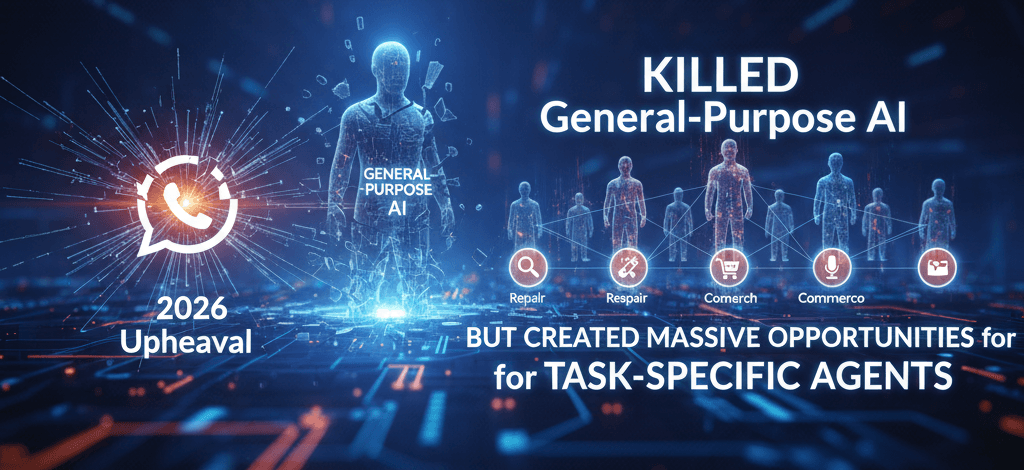
The January AI chatbot ban, portfolio pacing changes, and pricing restructuring are forcing smarter WhatsApp strategies. Here’s how to navigate the chaos—and why your CRM platform matters more than ever.
The Rapid Rise—and Sudden Shift
In 2024, businesses flocked to WhatsApp, integrating ChatGPT-style bots and scaling customer engagement at record speed. By mid-2025, WhatsApp had become a core B2B and B2C channel—but within months, the rules changed dramatically.
January 2026 brought a ban on general-purpose AI agents, layered on top of portfolio-level pacing (October 2025) and per-message pricing changes (July 2025). Regulatory pressure, regional pricing gaps, and unclear compliance guidance have left businesses scrambling.
What Changed in 2026? The Four Seismic Shifts
1. Portfolio Pacing & Tier Restructuring
WhatsApp removed legacy daily caps and allowed verified businesses to jump directly to higher tiers. However, an invisible portfolio-level pacing mechanism now throttles delivery based on message quality.
Campaigns can pause mid-delivery if blocks or reports spike.
Most businesses operate at ~80 MPS, meaning 100k messages take ~21 minutes to deliver.
Enterprise accounts with 1,000 MPS can deliver the same volume in ~100 seconds.
68–72% of businesses still rely on outdated 2024 assumptions.
2. AI Policy Reversal & Regulatory Uncertainty
On January 15, 2026, Meta banned general-purpose AI bots on WhatsApp. These were the ChatGPT-style assistants many teams had just deployed.
Chatbot usage had grown 60%, with 70% reporting higher customer satisfaction.
EU regulators later challenged the ban on competition law grounds.
Many regulated industries never adopted general-purpose AI due to GDPR and transparency risks—leaving others stuck waiting or scrambling to pivot.
3. Pricing Restructuring & Geographic Variation
Per-message pricing introduced in 2025 added complexity rather than clarity.
India: ~€0.022 per marketing message.
Germany: €0.11–€0.22 per message (up to 11x higher).
Additional hidden costs include compliance setup, AI disclosures, template approvals, and tier ramp-up delays.
4. Frequency Capping & Regional Restrictions
Businesses are now limited to two marketing messages per user per day, with marketing temporarily paused in the U.S.
The Task-Specific AI Agent Opportunity
The ban exposed a reality: general-purpose AI was never the right fit for regulated high-volume messaging.
Lead qualification agents
Appointment booking agents
Product recommendation bots
Support triage agents
According to McKinsey, task-specific AI can cut support costs by up to 50% and resolve up to 70% of queries without human intervention.
Why Your CRM Platform Matters in 2026
Generic CRMs and messaging tools fail to model pacing, costs, compliance, and AI restrictions.
Whatatalk: Built for WhatsApp’s 2026 Reality
Shared inbox with pacing intelligence
Transparent cost modeling by region and provider
Pre-built, policy-compliant AI agents
API-first CRM and system integrations
Ready for 2026?
Audit your setup, calculate true costs, deploy compliant AI, and choose platforms built for WhatsApp’s new reality.